Separation technology meets green chemistry: development of magnetically recoverable catalyst supports containing silica, ceria, and titania
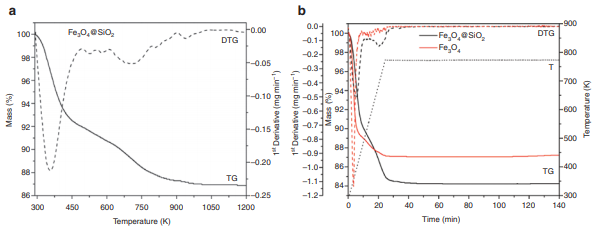
Abstract: Magnetic separation can be considered a green technology because it is fast, efficient, consumes low energy, and minimizes the use of solvents and the generation of waste. It has been successfully used in laboratory scale to facilitate supported catalysts’ handling, separation, recovery, and recycling. Only few materials are intrisically magnetic, hence the application of magnetic materials as catalyst supports has broaden the use of magnetic separation. Iron oxides, silica-coated iron oxides, and carbon-coated-cobalt are among the most studied catalyst supports; however, other metal oxide coatings, such as ceria and titania, are also very interesting for application in catalysis. Here we report the preparation of magnetically recoverable magnetic supports containing silica, ceria, and titania. We found that the silica shell protects the iron oxide core and allows the crystalization of ceria and titania at high temperature without compromising the magnetic properties of the catalyst supports.
Author(s): Vono, Lucas L. R.; Damasceno, Camila C.; Matos, Jivaldo R.; et al.
Pure and Applied Chemistry
Volume: 90 Issue: 1 Pages: 133-141 Published: 2018
DOI: http://dx.doi.org/10.1515/pac-2017-0504