Role of morphological characteristics on the conductive behavior of LaNiO3 thin films
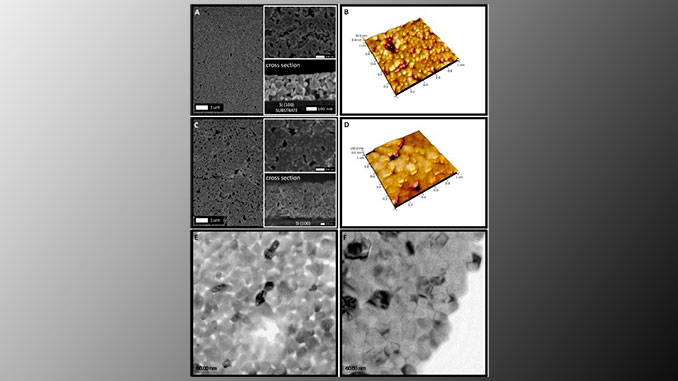
Abstract: LaNiO3 (LNO) thin films were synthesized via the polymeric precursor method and sintered using conventional and microwave heating sources. The samples were characterized by structural morphological and electrical techniques. The crystalline structure was analyzed by X-ray diffraction and indicated rhombohedral perovskite phase in both films sintered using conventional and microwave heating. The films morphology was evaluated by scanning and transmission electron microscopy, and atomic force microscopy, and the results point out that microwave heating exerts direct influence on the morphological characteristics of LNO films contributing towards the change in the grain size distribution, porosity and roughness. Conductivity was also investigated through four-probe measurements, which pointed out a conductive and ohmic behavior of the LNO thin films prepared via the polymeric precursor method where a direct relationship was found between the morphological characteristics and the electrical properties of LNO film. (C) 2016 Elsevier Ltd and Techna Group S.r.l. All rights reserved.
Author(s): Amoresi, RAC; Felix, AA; Lustosa, GMMM; Gasparotto, G; Simoes, AZ; Zaghete, MA
CERAMICS INTERNATIONAL
Volume: 42 Pages: 16242-16247 Published: NOV 1 2016
PDF: Role of morphological characteristics on the conductive behavior of LaNiO3 thin films
DOI: 10.1016/j.ceramint.2016.07.155