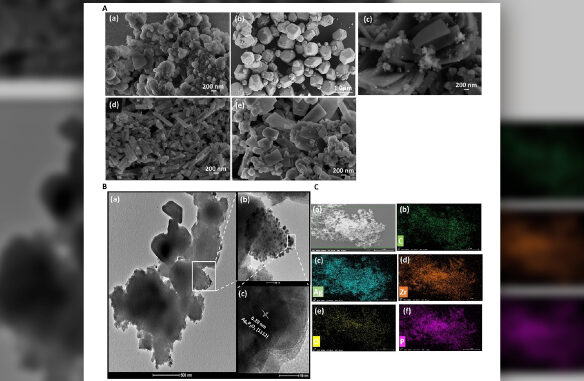
Abstract: The rational design of heterostructured photocatalysts with engineered architectures is crucial for advancing sustainable energy-environmental technologies. Here, a microwave-assisted strategy is developed to construct a Zr-MOF/Ag4P2O7 heterostructure, synergistically integrating the high surface area and robustness of zirconium-based-frameworks with the visible-light activity of silver pyrophosphate. The hybrid exhibits enhanced charge separation and solar photon harvesting, enabling efficient degradation of a broad range of organic dyes and fluoroquinolone antibiotics. The coexistence of hexagonal and orthorhombic Ag4P2O7 phases is proposed to form internal phase junctions that enhance charge-carrier separation, contributing to the superior photocatalytic performance of the heterostructure. The optimized MOF/Ag-2 composition (Zr:Ag = 1:2) achieved removal efficiencies above 95% for multiple pollutants, supported by mechanistic insights from dynamic light scattering (DLS), zeta potential, and electron paramagnetic resonance (EPR) analyses, which identified •OH and h+ as the dominant reactive species. Advanced characterization, LC-MS monitoring, and phytotoxicity assays validated the transformation of contaminants into less harmful intermediates. Importantly, Six-Flux Modeling demonstrated that the heterostructure absorbs nearly seven times more visible photons than UVA, confirming its solar responsiveness. These findings highlight Zr-MOF/Ag4P2O7 as a cost-effective and structurally engineered photocatalyst, offering a blueprint for the next generation of multifunctional materials tailored for sustainable environmental remediation and beyond.
Author(s): Letícia G. da Trindade, Antonio C. Roveda Jr., Marcelo Assis, Aline B. Trench, Yeison Núñez-de la Rosa, Luis Guillermo Cuadrado Durango, Carlos H. M. Fernandes, Juliana C. Barreiro, Márcio Daldin Teodoro, Moacir Rossi Forim, Lucia H. Mascaro, Elson Longo, Aryel Heitor Ferreira, Ivana Grčić, Daniel R. Cardoso, Edson A. Ticianelli
First published: 17/112025
DOI: https://doi.org/10.1002/adsu.202501297
CDMF
The CDMF, hosted at the Federal University of São Carlos (UFSCar), is one of the Research, Innovation and Dissemination Centers (RIDC) supported by the São Paulo State Research Support Foundation (Fapesp), and also receives investment from the National Council Scientific and Technological Development (CNPq), from the National Institute of Science and Technology of Materials in Nanotechnology (INCTMN).