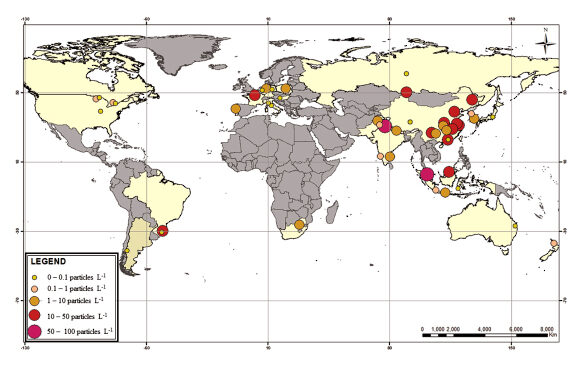
Abstract: Ecotoxicological studies involving microplastics (MPs) conducted on a laboratory scale may not always accurately mirror real environmental conditions (types, sizes, shapes, and concentrations of MPs). This review primarily focused on examining studies that investigated the prevalence of MPs in freshwater environments and accumulation in organisms worldwide, considering important factors such as morphology, particle size, and the specific polymer types involved. This review also encompassed ecotoxicological studies related to MPs, and ecological risk analyses were carried out based on the obtained ecotoxicological data. Based on the extensive dataset collected, we determined the hazardous concentration for 5% of the tested organisms (HC5) and estimated for the first time a predicted noneffect concentration (PNEC) value for two distinct types of MPs polymers: polystyrene (PS) and polyethylene (PE), based on the species sensitive distribution (SSD) curves obtained from nonobserved concentration (NOEC) values, with 0.003 mg L−1 for PS and 0.011 mg L−1 for PE. Furthermore, another PNEC value for 7 types of MPs (PE, PS, polyvinyl chloride, PA6, polyester, polyethylene terephthalate, and ethylene acrylic acid copolymer (EEA copolymer)) was calculated (0.0027 mg L−1 or 2.61 particles L−1). Subsequently, the risk quotient (RQ) was computed utilizing data obtained from the measured environmental concentrations of 18 places. An RQ value of 0.094 was obtained, inferring that MPs have a low-risk potential globally. However, when the RQ values were examined for each country separately, they exhibited significant variability (RQ = 22.06 in Malaysia and 0.000008 in Australia). Overall, this review provides a comprehensive overview of the current knowledge on MP abundance in freshwater environments, the associated ecotoxicological research to reinforce the outcomes derived from the risk analysis, and their accumulation in biota.
Author(s): Leslie L Morales-Espinoza, Renan Castelhano Gebara, Elson Longo, Renata Fracácio
First published: 1/2025
https://doi.org/10.1093/etojnl/vgae008
CDMF
The CDMF, hosted at the Federal University of São Carlos (UFSCar), is one of the Research, Innovation and Dissemination Centers (RIDC) supported by the São Paulo State Research Support Foundation (Fapesp), and also receives investment from the National Council Scientific and Technological Development (CNPq), from the National Institute of Science and Technology of Materials in Nanotechnology (INCTMN).