
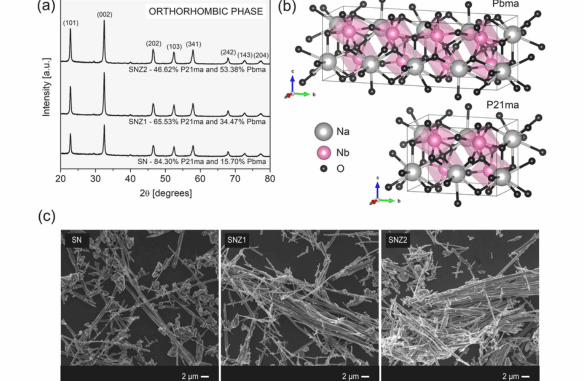
Abstract: NaNbO3 doped with Zn (0.00, 0.02, and 0.05 mmol) was synthesized by the microwave-assisted hydrothermal method. Photocatalytic and antibacterial activities were investigated. X-ray diffraction revealed the coexistence of two orthorhombic symmetries (P21ma and Pbma), with doping promoting a progressive increase in the Pbma fraction. All samples exhibited a fiber-like shape (diameter of ∼200 nm), which remained unchanged with doping. The low Zn content (0.02 mmol) reduced the band gap energy from 3.08 to 2.95 eV. As a result, this sample exhibited superior photocatalytic activity, achieving 100 % RhB dye degradation within 45 min, under UV light. Scavenger tests revealed that hydroxyl radicals, holes, and superoxide radical anions were the main active species involved in the photocatalytic reaction. Additionally, the photocatalyst demonstrated excellent recyclability over three consecutive cycles. Pure NaNbO3 exhibited strong antibacterial activity, completely inhibiting the growth of S. aureus, E. coli, and K. pneumoniae at the tested concentrations. Although the Zn-doped sample also demonstrated antibacterial action, the response was concentration-dependent. This study is the first report on Zn doping in NaNbO3, as well as the first investigation of its antibacterial activity against K. pneumoniae and S. aureus.
Graphical abstract:

Author(s): Daiane Fernandes, Cristiane Raubach, Carla Trassante, Vagner Dias, Luize Melo, Marcelle Silveira, Ramon Carvalho, Mario Moreira, Pedro Jardim, Mateus Ferrer, Janice Giongo, Rodrigo Vaucher, Elson Longo, Sergio Cava
First published: 24/04/2025