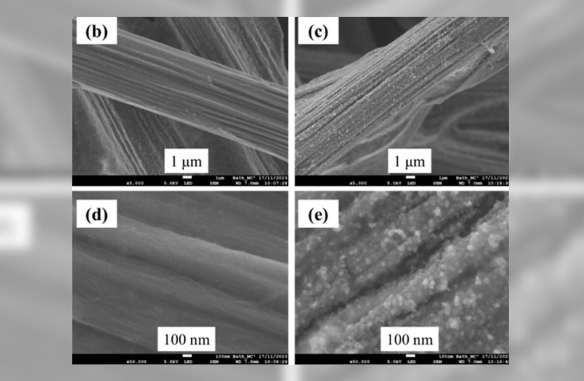
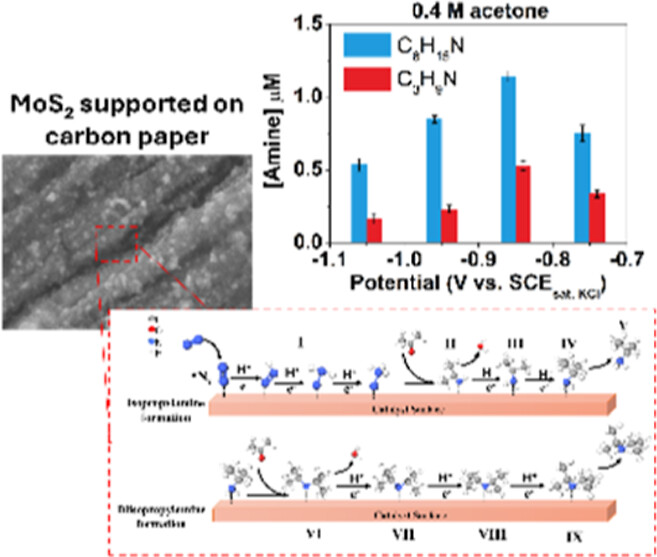
Abstract: The electrocatalytic utilization of nitrogen compounds for C–N coupling chemistry is a promising research area with significant potential to become a sustainable method for producing organonitrogen molecules. The most commonly employed C–N coupling reaction is reductive amination. In this study, we demonstrate an alternative electrochemical reductive amination reaction using N2 gas as the nitrogen source, which enables the production of isopropylamine and diisopropylamine in a single process. For instance, these reactions occur at amorphous MoS2-coated carbon paper electrodes. This opens the doors to complex molecule electrosynthesis directly from the gas feed. The effects of the acetone concentration and applied potential on reaction yields are investigated. Direct gas feed is demonstrated as a sustainable electro-organic synthetic technology for organic amines. There is an increase in the production of C3H9N and C6H15N with increasing acetone concentration. For 0.4 M acetone under N2 (at pH 7.0), isopropylamine and diisopropylamine yield rates are 3.1 and 6.7 μg h–1 mg–1, respectively, at −0.85 V SCEsat. KCl. The highest faradaic efficiency is obtained at −0.75 V SCEsat. KCl for C3H9N (0.46%) and C6H15N (2.0%). At more negative potentials, there is a decrease in the production of both amines mainly due to the enhanced/competing HER. In all cases, diisopropylamine is the main organic product. This work provides a new and attractive strategy for organic amine synthesis via one-step electrochemical nitrogen reduction.
Graphical abstract:
Author(s): Caio VS Almeida, Ana B Cardile, Lucia H Mascaro, Frank Marken
First published: 6/2/2026