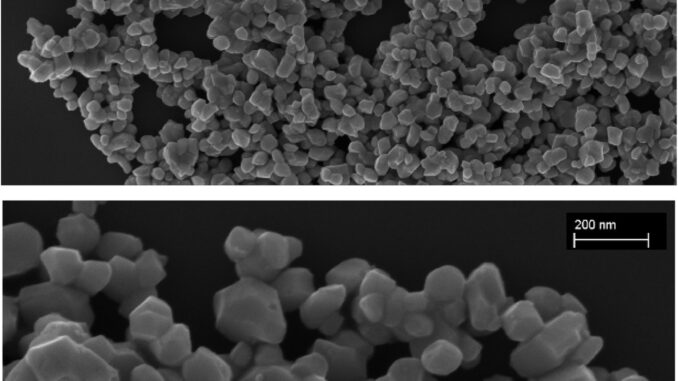
Abstract: The semiconductor copper tungstate (CuWO4) may end up in aquatic ecosystems since it has the potential for water decontamination. The toxic effects of CuWO4 are totally unknown for eukaryotic organisms. In view of this, we aimed to evaluate the toxicity of CuWO4 particles (size of 161.5 nm) on the cosmopolitan green microalga Raphidocelis subcapitata (a standardized test-organism for ecotoxicological assays), analyzing the growth and multiple photosynthetic parameters obtained by pulse amplitude modulated (PAM) fluorometry. At 1.2 mg l-1, the growth was affected, and there was an increase in reactive oxygen species (ROS) after 72 h The effective efficiency (ɸM’) of photosystem II (PSII) was affected at 13.1 mg l-1, while the efficiency of the oxygen-evolving complex (OEC), responsible for the water-splitting process, decayed at 5.6 mg l-1. According to quenching parameters, energy allocated to photosynthetic processes (qP) decreased, indicating a malfunctioning of the PSII. We also observed a 50 % increase in the non-regulated energy dissipation by heat and fluorescence (Y(NO)), and a 50 % decrease in the regulated energy dissipation (NPQ), suggesting difficulties for algae to cope with light. Rapid light curves (RLC) were the second most sensitive parameter, as we observed a decay of the relative maximum electron transport rate (rETRmax) at 2.8 mg l-1. Therefore, since the microalga R. subcapitata was affected by concentrations up to 1.2 mg l-1 (0.01 mg l-1 dissolved Cu), it is important to evaluate carefully the use of CuWO4 to decontaminate natural waters, considering the protection of the aquatic biota.
Author(s): Renan Castelhano Gebara, Cínthia Bruno de Abreu, Giseli Swerts Rocha, Adrislaine da Silva Mansano, Marcelo Assis, Ailton José Moreira, Mykaelli Andrade Santos, Thalles Maranesi Pereira, Luciano Sindra Virtuoso, Maria da Graça Gama Melão, Elson Longo
First published: 01/02/2025
DOI: https://doi.org/10.1016/j.aquatox.2025.107245
CDMF
The CDMF, hosted at the Federal University of São Carlos (UFSCar), is one of the Research, Innovation and Dissemination Centers (RIDC) supported by the São Paulo State Research Support Foundation (Fapesp), and also receives investment from the National Council Scientific and Technological Development (CNPq), from the National Institute of Science and Technology of Materials in Nanotechnology (INCTMN).