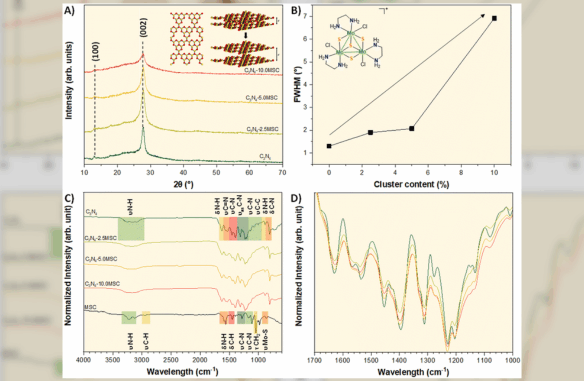
Abstract: In this study, a hybrid photocatalyst based on carbon nitride (g-C3N4) modified with the molecular cluster [Mo3S4Cl3(en)3]Cl was developed and evaluated for the visible-light-driven degradation of ciprofloxacin (CIP). The incorporation of the cluster introduced structural and electronic modifications in g-C3N4, as demonstrated by spectroscopic, microscopic, and electrochemical analyses. Transient photocurrent responses and Mott–Schottky plots revealed enhanced charge separation and a positive shift in flat-band potential, consistent with increased electron mobility. Impedance spectroscopy indicated reduced charge-transfer resistance, supporting more efficient carrier transport. The optimized sample containing 2.5 wt% cluster achieved complete degradation of CIP in 150 minutes and 65% mineralization under visible light. Kinetic modeling showed pseudo-first-order behavior with a 12-fold increase in the rate constant compared to pristine g-C3N4. The material maintained high performance under different pH conditions, catalyst dosages, and real water samples, including tap and river water. Interference studies with common ions revealed moderate inhibition, highlighting the importance of matrix composition. Fluorescence and absorbance-based tests identified hydroxyl radicals and singlet oxygen as the main reactive oxygen species (ROS). A mechanism is proposed in which the Mo3S4 cluster acts as an electron trap within the g-C3N4 matrix, facilitating charge separation and boosting ROS generation under visible light. The hybrid catalyst also exhibited good recyclability, maintaining over 50% of its mineralization capacity after five cycles. These results demonstrate the relevance of electron trap engineering in molecular–semiconductor hybrids for the efficient and robust photodegradation of emerging contaminants under environmentally realistic conditions.
Author(s): Mayra Luiza Gonçalves Rodrigues, Juanjo Mateu-Campos, Anelisse Brunca Silva, Maria Gutiérrez-Blanco, José Balena Gabriel Filho, Caue Ribeiro, Rosa Llusar, Juan Andrés, Elson Longo, Marcelo Assis
First published: 12/11/2025
DOI: 10.1039/D5TA06478C