
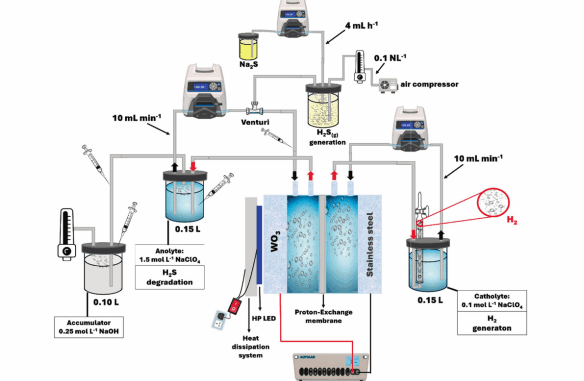
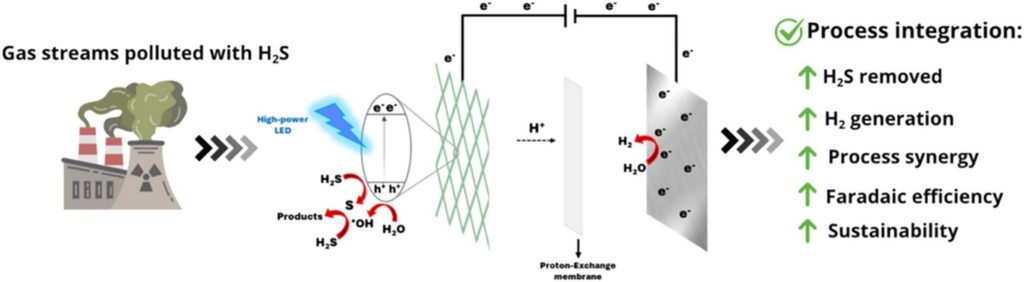
Abstract: Hydrogen sulfide (H2S) is a highly toxic and corrosive gas commonly found in industrial emissions, posing serious environmental and operational risks. This work proposes an innovative photoelectrocatalytic strategy for the simultaneous degradation of gaseous H2S and the generation of green hydrogen (H2) under flux conditions. The system integrates gas-liquid absorption with electrochemical and photoelectrochemical oxidation, employing a WO3 photoanode and a stainless steel cathode separated by a proton exchange membrane. The performance of the electrocatalytic and photoelectrocatalytic configurations was systematically evaluated regarding H2S removal efficiency, hydrogen production, and energy consumption. The photoelectrocatalytic process exhibited superior activity, achieving a degradation of 8.2 mg S with a Coulombic efficiency of 3600 mg S Ah−1 for H2S oxidation and a Faradaic efficiency of 60% for H2 evolution at an applied current density of 0.33 mA cm−2. Illumination with a 10 W high-power blue LED significantly increased charge separation and reduced the cell potential, resulting in higher energy efficiency. Post-reaction characterization by X-ray photoelectron spectroscopy (XPS) demonstrated partial sulfur deposition on the WO3 surface and the presence of oxidized sulfur species. Overall, the results demonstrate that photoelectrocatalysis under optimized conditions offers an efficient and sustainable route for simultaneous H2S reduction and hydrogen generation, providing a promising dual-purpose platform for environmental remediation and renewable energy production.
Graphical abstract:
Author(s): Roberta Y.N. Reis, Alberto Rodríguez-Gómez, Caio V.S. Almeida, Lucia H. Mascaro, Manuel A. Rodrigo
First published: 3/2/2026