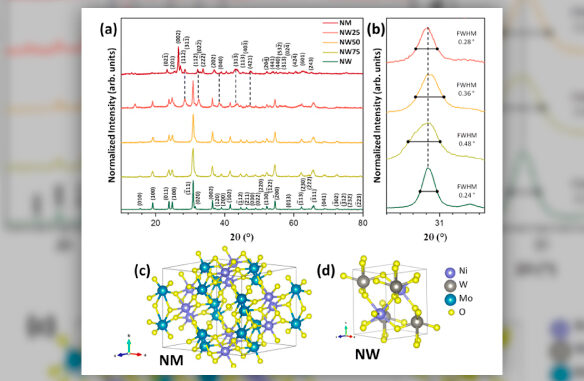
Abstract: Solid solutions, formed by combining two transition metal oxides with distinct properties, offer promising potential for optimizing functional characteristics that may be lacking in the parent materials. In this study, NiWO4 and NiMoO4 semiconductors and homogeneous NiW1−xMoxO4 (x = 25, 50, and 75%) solid solutions were successfully synthesized via a co-precipitation method followed by heat treatment, without any surfactants or toxic solvents. Using a combination of characterization techniques—including X-ray diffraction, Raman and infrared spectroscopy, X-ray fluorescence, diffuse reflectance spectroscopy, and photoluminescence (PL) spectroscopy—alongside density functional theory calculations, we elucidate the relationship between the structure, electronic properties, and PL emissions at the atomic level. Furthermore, we propose a relay mechanism in the conduction band, where an electron transport ladder through the Ni–O–W/Mo framework acts as a driving force to modulate PL emissions.
Author(s): Amanda Fernandes Gouveia, Marcelo Assis, Lara Kelly Ribeiro, Eduardo de Oliveira Gomes, Marcio Daldin Teodoro, Elson Longo, Juan Andres
First published: 24/2/2025
DOI: 10.1039/D4TC05251J
CDMF
The CDMF, hosted at the Federal University of São Carlos (UFSCar), is one of the Research, Innovation and Dissemination Centers (RIDC) supported by the São Paulo State Research Support Foundation (Fapesp), and also receives investment from the National Council Scientific and Technological Development (CNPq), from the National Institute of Science and Technology of Materials in Nanotechnology (INCTMN).