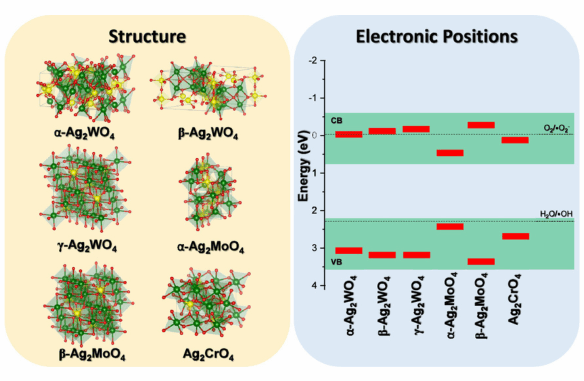
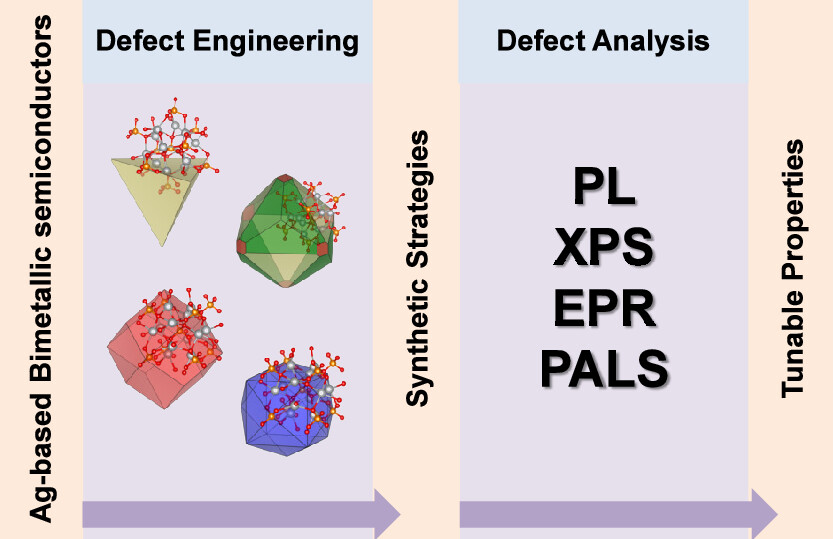
Abstract: Since the mid-20th century, the interaction between light and inorganic semiconductors plays not only a key role in numerous fascinating phenomena but also provides the physical foundations for the development of many modern technologies focused on health, environmental, and energy solutions. Among these materials, silver-based bimetallic semiconductors have garnered attention due to their enhanced functional properties, which are controlled by the presence and distribution of structural and electronic defects. These defects directly impact key physicochemical properties, making them essential for the development of materials with improved functionalities. Modifying synthetic and postsynthetic parameters is crucial for controlling the type, density, and distribution of these defects in materials. However, achieving precise control of these defects remains a challenge and requires a deeper understanding of the relationship between synthetic conditions and defect formation. This work provides a comprehensive review of how modifications in synthesis methods influence material properties, with a particular focus on understanding their impact on material defects. Specifically, this study examines silver-based bimetallic semiconductors, including Ag2WO4, Ag2MoO4, and Ag2CrO4. Additionally, strategies involving advanced defect characterization techniques such as photoluminescence spectroscopy (PL), X-ray photoelectron spectroscopy (XPS), electron paramagnetic resonance (EPR), and positron annihilation lifetime spectroscopy (PALS) are discussed, as these methods are gaining prominence in defect analysis. By exploring the interplay between synthetic control and its impact on defects in these materials, this study highlights the critical role of defect engineering in advancing the application potential of silver-based bimetallic semiconductors.
Graphical abstract:
Author(s): Marcelo Assis, Ana Claudia Muniz Rennó, Juan Andrés, Elson Longo
First published: 28/05/2025