publicado em phys.org
Brazilian scientists have made advances in an area recognized by the 2025 Nobel Prize in Chemistry: the development and application of metal-organic frameworks (MOFs). These are porous crystalline materials that have the potential to revolutionize environmental and energy technologies. The study involved researchers affiliated with the Center for Development of Functional Materials based at the Federal University of São Carlos (UFSCar).
The study introduces a novel molecular architecture based on zirconium MOFs that is designed to efficiently degrade emerging water contaminants, including industrial dyes and antibiotics. This research builds upon the scientific advances that led to last year’s Nobel Prize in Chemistry being awarded to Susumu Kitagawa, Richard Robson, and Omar Yaghi for creating a new form of molecular architecture. The laureates were responsible for establishing the fundamentals of MOFs, which are materials formed by the combination of metal ions and organic ligands that organize themselves into highly porous crystalline networks.
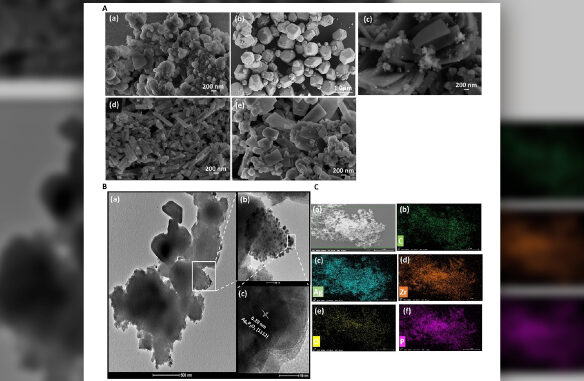
The researchers’ work is published in Advanced Sustainable Systems. In the article, they describe developing an innovative heterostructure that integrates a zirconium MOF (Zr-MOF), which is known for its high chemical stability, with the semiconductor silver pyrophosphate. This combination creates a material that can efficiently absorb sunlight, promote the separation of electrical charges, and generate reactive species that degrade persistent pollutants in aqueous media.
The results demonstrate removal efficiencies greater than 95% for different contaminants, as well as the transformation of these substances into significantly less toxic intermediates. This was confirmed through advanced liquid chromatography coupled with mass spectrometry analyses and phytotoxicity tests.
One unique aspect of the study is its use of optical modeling based on the Six-Flux model. This model revealed that the material absorbs nearly seven times more photons in the visible spectrum than in the ultraviolet range. This finding reinforces the potential of the material for sustainable, solar-powered applications.