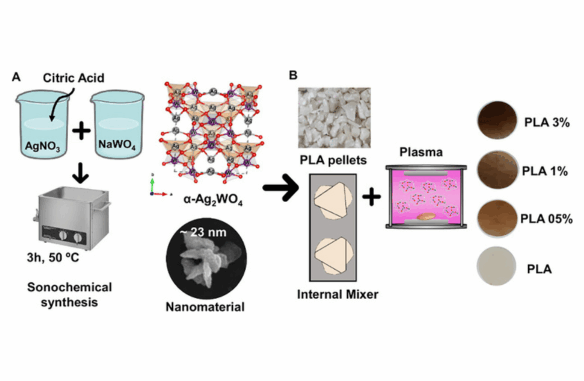
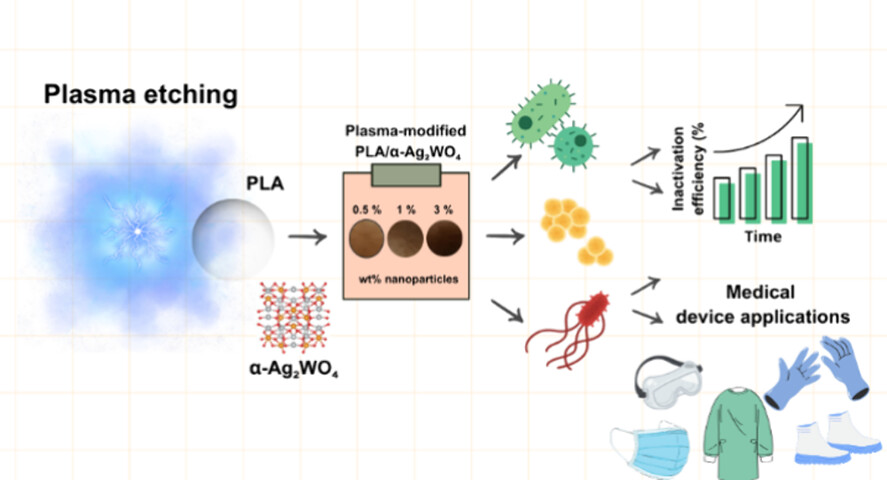
Abstract: Poly(lactic acid) (PLA) is a biobased polymer with versatile applications, particularly in biomedical and packaging sectors. However, its limited antimicrobial properties, low crystallization kinetics, and restricted surface characteristics often require modification. Incorporating semiconductor nanoparticles enhances its antimicrobial performance and crystallization kinetics, while plasma treatment modifies surface properties, such as chemical composition, roughness, and tension, without affecting the bulk properties. Although plasma treatment has been scarcely explored, it can enable the selective removal of polymer layers to expose the particles of interest and enhance antimicrobial performance. In this work, α-Ag2WO4 nanoparticles were incorporated into biobased PLA to confer antimicrobial properties. The samples were then exposed to oxygen plasma for selective polymer removal, further enhancing these properties. XPS, and SEM/EDS results revealed that plasma treatment selectively removed PLA, exposing α-Ag2WO4 particles and modifying the polymer surface. This process, confirmed by AFM, involves radical oxidation and chain scission, leading to an ablation phenomenon. Additionally, exposing nanocomposite films to oxygen plasma increases surface tension due to particle incorporation, suggesting the introduction of polar groups. While the dispersive component remains unchanged, the polar component increases with greater particle exposure on the surface, resulting from plasma etching. This effect alters the electronic density and surface charge, leading to a reduction in the contact angle. Finally, the antimicrobial performance was analyzed for different pathogens at 2, 8, and 16 h. The plasma treatment exhibited higher efficiency for all evaluated composites than the untreated ones. Notably, the improved antimicrobial performance observed in plasma-treated materials after a 16-h exposure period was impressive, with the 3% concentration of α-Ag2WO4 exhibiting optimal microorganism-killing efficiency. These findings highlight the potential of the plasma-treated PLA/α-Ag2WO4 composite for the development of hospital devices designed to inhibit the growth and spread of pathogens.
Graphical abstract:
Author(s): Leticia Akemi Onue de Jesus, Maciel L Barbosa, Lara K Ribeiro, Isabelly Bertochi Veroneze, Mateus Oliveira Costa, Mariana Ottaiano Gonçalves, Cristina Paiva de Sousa, Elson Longo, Sandra A Cruz
First published: 26/05/2025