Writers: F. Willian de S. Lucas, Alan R.F. Lima, Lucia H. Mascaro
Keywords: Solar cell, chalcopyrite, CIGSe, semiconductor electrodeposition
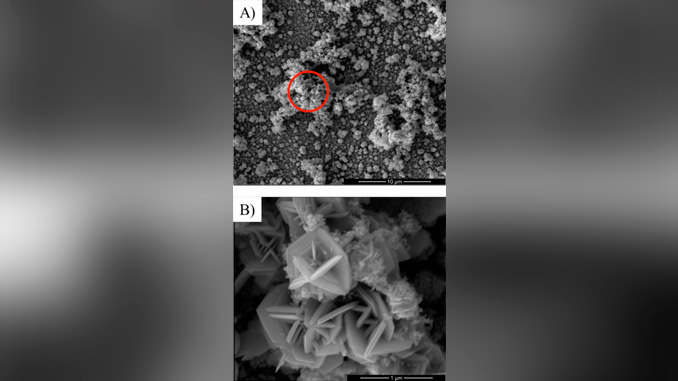
Abstract: The codeposition of Cu, In, Ga and Se from pH 1.5 at Na2SO4/H2SO4 solution onto fluorine doped tin oxide (FTO) was studied. The effects of Triton 100-X as a noncomplexing and nonionic additive in the electrodeposition process was evaluated. At optimised experimental conditions was possible to obtain of Ga-doped CuInSe2 films (CIGSe). The films presented two different morphologies, one layer formed by globular structures and another layer constituted of lamellar clusters. The major phase in the films was CIGSe, but binary phases as InSe and CuSe were also identified. The value of the band gap was at about 1.35 eV for all the films. It was observed that the additive presence in electrolytic bath reduces the number of surface defects and increases the crystallinity and purity of the electrodeposited CIGSe.