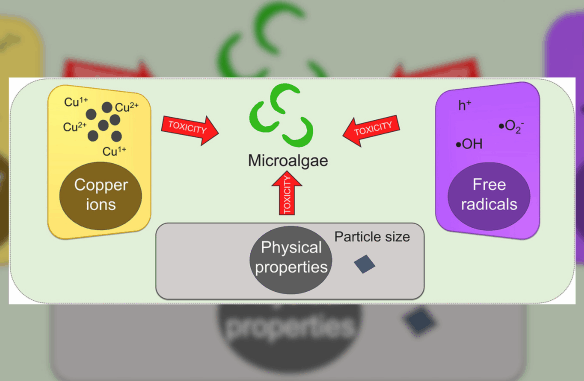
Abstract: Semiconductors have multiple applications in society, including photocatalysis and electrochemical sensors. Copper tungstate (CuWO4) particles can degrade organic compounds from water, but their deleterious effects on aquatic biota must be evaluated before their widespread use. We aimed to assess the toxicity of CuWO4 on the standardized microalga Raphidocelis subcapitata using a multiparameter approach. Our study comprehends the analysis of growth, lipid classes, carbohydrates, chlorophyll a, ROS production, photosynthesis, cell morphology, and theoretical calculations, to elucidate the toxicity mechanisms of this compound. We found that CuWO4 affected the growth at 2.8 mg/L, followed by an increase in cell granularity and volume at 2.8 and 5.6 mg/L, respectively. We also observed increased intracellular ROS production, photosynthesis impairment, and changes in lipid classes (especially triacylglycerol – TAG, with potential to biofuels), carbohydrates and chlorophyll a content. Besides the toxic effects caused by copper ion release and the physical and chemical effects of the particles, experimental and theoretical chemical analysis showed that the semiconductor CuWO4 itself produces oxidative species, especially photogenerated h+ (holes), and hydroxyl (⦁OH) and superoxide (⦁O2−) radicals, which can be associated with the localization of electronic levels summed to the undercoordination degree of the exposed surfaces. Our study shows that although CuWO4 is promisor in water decontamination, it is toxic to a green microalga at the base of aquatic food chains, being a possible threat to these ecosystems. Further ecotoxicological studies with other aquatic organisms is highly advised to better understand the effects of this semiconductor on entire environments.
Author(s): Renan Castelhano Gebara, Cínthia Bruno de Abreu, Giseli Swerts Rocha, Marcelo Assis, Marisa Carvalho de Oliveira, Renan Augusto Pontes Ribeiro, Maria da Graça Gama Melão, Elson Longo
First published: 10/10/2025