
[otw_shortcode_button href=”http://cdmf.org.br/wp-content/uploads/2016/11/Silva-2016-Microwave-assisted-h.pdf” size=”large” icon_type=”general foundicon-down-arrow” icon_position=”left” shape=”square” color_class=”otw-red” target=”_blank”]See PDF[/otw_shortcode_button] [otw_shortcode_button href=”http://dx.doi.org/10.1016/j.saa.2015.08.047″ size=”large” icon_type=”general foundicon-page” icon_position=”left” shape=”square” color_class=”otw-green” target=”_blank”]Full Length Article[/otw_shortcode_button]
Writers: M.D.P. Silva, R.F. Gonçalves, I.C. Nogueira, V.M. Longo, L. Mondoni, M.G. Moron, Y.V. Santana, E. Longo
Keywords: Ag2WO4; Ag2MoO4; Photoluminescence; Morphology; Raman spectroscopy
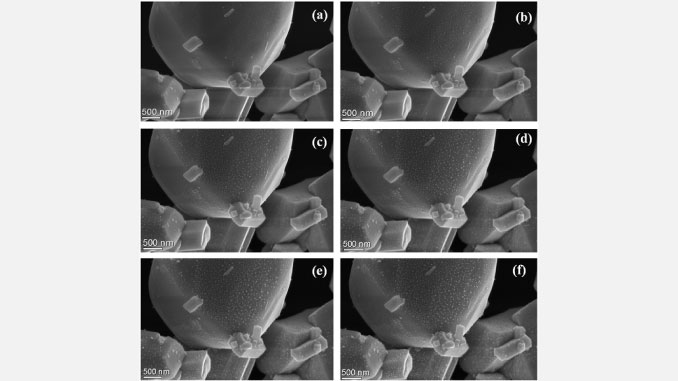
Abstract: Ag2W1 -xMoxO4 (x = 0.0 and 0.50) powders were synthesized by the co-precipitation (drop-by-drop) method and processed using a microwave-assisted hydrothermal method. We report the real-time in situ formation and growth of Ag filaments on the Ag2W1 -xMoxO4 crystals using an accelerated electron beam under high vacuum. Various techniques were used to evaluate the influence of the network-former substitution on the structural and optical properties, including photoluminescence (PL) emission, of these materials. X-ray diffraction results confirmed the phases obtained by the synthesis methods. Raman spectroscopy revealed significant changes in local order–disorder as a function of the network-former substitution. Field-emission scanning electron microscopy was used to determine the shape as well as dimensions of the Ag2W1 -xMoxO4 heterostructures. The PL spectra showed that the PL-emission intensities of Ag2W1 -xMoxO4 were greater than those of pure Ag2WO4, probably because of the increase of intermediary energy levels within the band gap of the Ag2W1 -xMoxO4 heterostructures, as evidenced by the decrease in the band-gap values measured by ultraviolet–visible spectroscopy.


