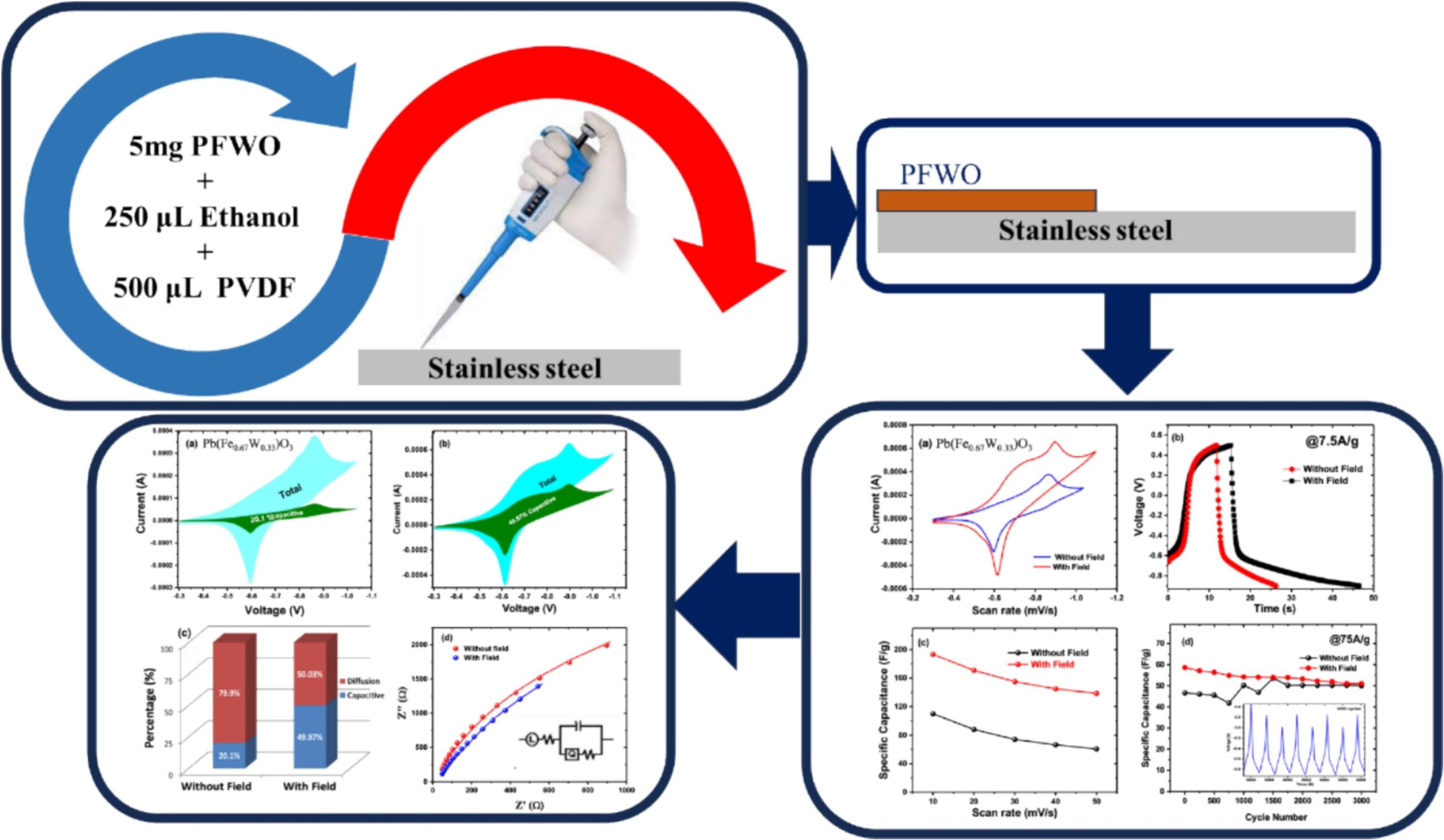
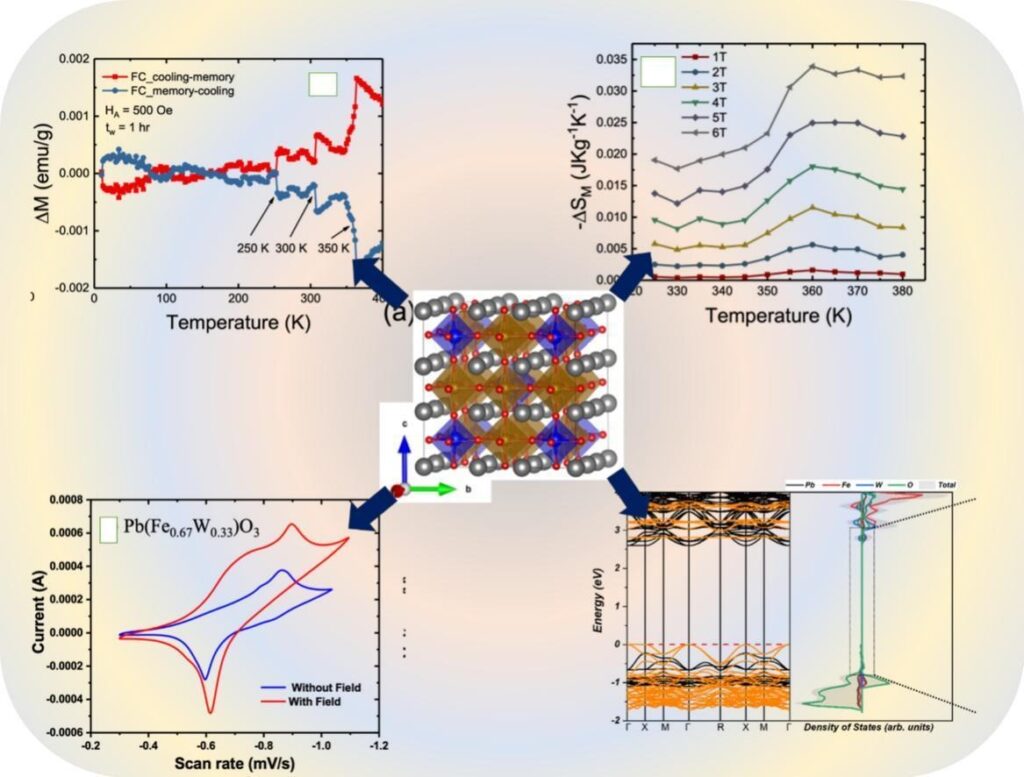
Abstract: The present work reports the a comprehensive study of the structural, magnetic, and electrochemical properties of Pb(Fe₀.₆₇W₀.₃₃)O₃ (PFWO), highlighting its potential as a multifunctional material for room-temperature magnetocaloric, memory, and energy storage applications. Structural analysis via X-ray diffraction (XRD) and Rietveld refinement confirms a pseudo-cubic perovskite structure (space group Pm-3 m), supported by Raman spectroscopy that reveals characteristic A₁g, Eg, and 2F₂g modes due to local lattice distortions. Magnetic susceptibility measurements demonstrate a paramagnetic-to-antiferromagnetic transition at ∼344 K, with weak ferromagnetic ordering below 7 K. The PFWO exhibits a notable magnetocaloric effect, with significant magnetic entropy changes under 1–6 T. Electrochemical performance, evaluated through cyclic voltammetry (CV), galvanostatic charge – discharge (GCD), and electrochemical impedance spectroscopy (EIS), shows a substantial increase (80–110 %) in specific capacitance under a low magnetic field (30 mT), attributed to enhanced charge storage and reduced charge transfer resistance (from 35.47 to 31.59 Ω). Excellent cycling stability is observed over 10,000 cycles. Density functional theory (DFT) calculations were performed and corroborated well with the structural, electronic, vibrational, and magnetic properties of PFWO. The increased specific capacitance is well supported by DFT calculations, attributed to structural disorder or instability. Overall, PFWO is a promising multifunctional multiferroic material with potential applications in room-temperature refrigeration, magnetic memory, and supercapacitors.
Graphical abstract:
Author(s): Nilesh Chougala, K Manjunatha, AS Patil, Tsu-En Hsu, Shih-Lung Yu, Sheng Yun Wu, Marisa C Oliveira, Elson Longo, Renan AP Ribeiro, Hsin-Hao Chiu, Ming-Kang Ho, Sudhindra Rayaprol, Basavaraj Angadi, Shantinath Latthe, Sameer Kulkarni, Shidaling Matteppanavar
First published: 30/10/2025