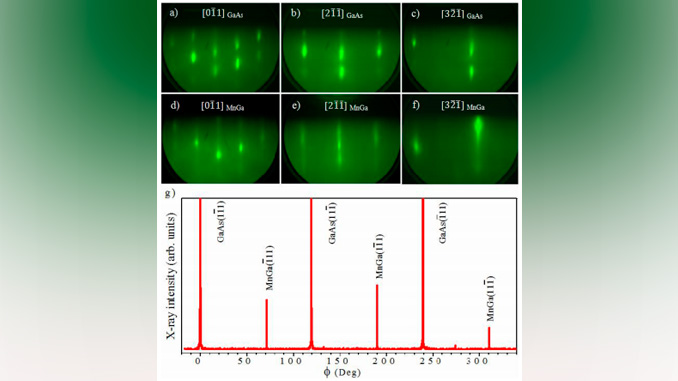
RHEED patterns taken along the directions
[011], [211], and [321] of epi-ready GaAs(111)B substrates
after removal of the oxide layer at 580 C are,
respectively, shown in (a), (b), and (c). RHEED patterns
for the same directions of GaAs after the growth
of MnGa epilayer are respectively shown in (d), (e),
and (f). In panel (g) is shown the / scan measured at
room temperature for the MnGa epilayers by turning
the film plane around the direction [111] of the GaAs
substrate, which is 70.5 off from the film normal.
FIG. 2
Writers: A. W. Arins; H. F. Jurca; J. Zarpellon; J. Varalda; I. L. Graff1; A. J. A. de Oliveira; W. H. Schreiner; and D. H. Mosca.
Keywords: ultra-thin films; magnetization
Abstract: We report on high quality MnGa epilayers directly grown on GaAs(111)-(1 × 1) reconstructed surface. MnGa layers are characterized by the stacking of (111) planes of tetragonal zinc-blende structure, which are rotated by 11° with respect to the underlying (111) planes of the GaAs lattice. These ultra-thin MnGa epilayers with lattice parameters a = 0.55 nm and c = 0.61 nm are stabilized for thickness between 5 and 20 nm with a net magnetic moment of 3.2 μB per Mn atom. These epilayers are potentially suited for semiconductor spintronics applications due to the reversal of its magnetization in relatively low magnetic fields.
O CDMF é um dos Centros de Pesquisa, Inovação e Difusão (CEPID) apoiados pela FAPESP. O Centro também recebe investimento do CNPq, a partir do Instituto Nacional de Ciência e Tecnologia dos Materiais em Nanotecnologia (INCTMN).
Writers: Ricardo H. Gonçalves and Edson R. Leite Keywords: semiconductors; films; hematite ABSTRACT: Hematite is one of the most promising semiconductors used to convert solar irradiation directly into chemical energy (molecular hydrogen and oxygen) via water splitting. Although several methods […]
Writers: Rafael A. Ferreira, Maria E. dos Santos, Cássio Morilla-Santos, Ronan Lebullenger, Octavio Peña, Paulo N. Lisboa-Filho Keywords: : Powders: chemical preparation; X-ray methods; Magnetic properties; Perovskites Abstract: Polycrystalline oxide materials with nominal compositions BiMn2O5 and Bi0.9Eu0.1Mn2O5were obtained […]
Writers: Marcela F. Silva, Mariani A. Ciciliatti, Ana A. W. Hechenleitner, Rebeca Peñalva, Maite Agüeros, Juan M. Irache, Adilson J. A. de Oliveira, Ammad A. Farooqi, Edgardo A. G. Pineda Keywords: maghemite; nanocapsules; optimization; poly (ɛ- caprolactone); […]